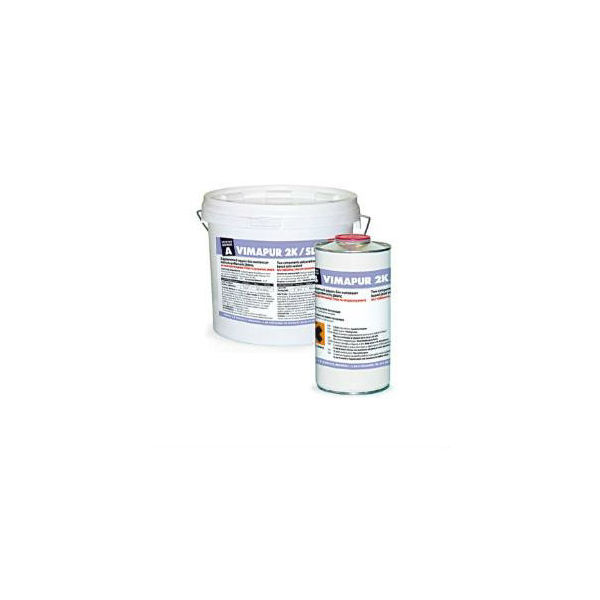
VIMAPUR 2K/SL | Polyurethane sealant
Two-component sealant based on polyurethane resins for floors
Polyurethane sealant for concrete floors
Polyurethane floor sealant
Polyurethane sealant for seams
VIMAPUR 2K/SL | When mixed, the two components polymerize and turn into an elastic and homogeneous mass.
Recommendations for the use of polyurethane sealant
-
Sealing of concrete seams in civil and industrial buildings.
-
In hydrotechnical facilities (irrigation, water supply, canals, reservoirs, etc.);
-
It is used for deformation seams with a high working load, which depend on the length of structural elements, the coefficient of expansion of which due to temperature changes during the year should not exceed 25-30% of the original width of the seam.;
-
Ideally, it is recommended that the maximum width of the seam should be no less than 1-1.5 cm, and the maximum width no more than 5 cm.
-
However, the sealant can be used where the width of the seam reaches 8 cm.
-
The filling depth is brought to 50% of the width of the seam, but the minimum limit is 1.5 cm.
- The sealant has excellent UV resistance and thermal stability (it contains UV stabilizers and antioxidants).
Weather conditions during application
-
Rain, as well as temperatures up to 10°C or more than 35-40°C, should be avoided, because in such cases special conditions are required.
- VIMAPUR 2K/SL complies with DIN 18540.
| Non-polymerized sealant |
VIMAPUR 2K/SL |
| Density at 23 °C |
1.45 g/cm3
|
| Application temperature |
+15 oC - +35 oC
|
| Viability |
20-60 min
|
| Polymerization speed |
1-2 days
|
|
Depending on weather conditions
|
|
| Polymerized sealant |
VIMAPUR 2K/SL |
| Tension on expansion 100% (DIN EN 28339) |
0.18 N/mm2
|
| Tensile strength limit (DIN EN 28339) |
0.35 N/mm2
|
|
Elongation at break (DIN EN 28339) |
400%
|
| Hardness (according to Shore A) |
16
|
| Ability to move |
± 25%
|
| Restoration of 100% expansion |
90%
|
Preparation
-
The walls of the seams should be thoroughly cleaned of loose particles, dust, etc. blowing with compressed air;
-
Apply a special seam primer to the walls of the seams to strengthen the adhesion of the sealant;
-
The depth of filling is regulated, if necessary, with the use of a cord made of foamed polyethylene;
-
In addition, in this case, the adhesion of the sealant to the seam walls is improved, and the sealant can be freely deformed following the expansion and contraction of the seam;
-
If the depth of the seam does not allow the use of a polyethylene cord, we recommend using a polyethylene film at the bottom of the seam for the same reason.
Sealing
-
Two components, packaged in a certain proportion;
-
When using, they are thoroughly mixed using a mixer, for example, a screw nozzle on a drill;
-
Mixing should occur until the mixture is completely homogeneous. Since the two components are of different colors (A: white - B: black), homogeneity can be determined visually (when the mixture gets a uniform gray color, without dark or light spots or stripes) - mixing is complete;
-
Ready-made sealant is applied in seams with the help of a special gun or spatula (on small areas);
- The surface of the still unhardened sealant is leveled with a spatula so as to form a negative crescent.