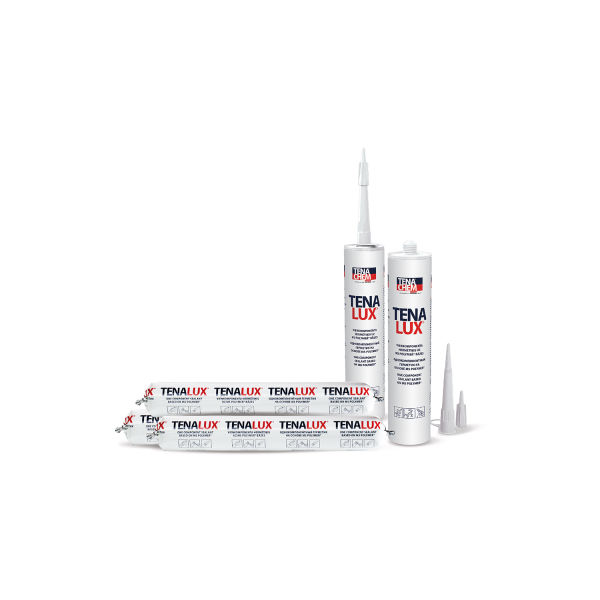
TENALUX 131L | Sealant for industrial applications
One-component sealant for underlays based on MS Polymer
MS polymer sealant for concrete pads
MS sealant for underlay
MS Polymer joint sealant
TENALUX 131L | MS polymer sealant
-
Ready-to-use one-component sealant based on MS Polymer for sealing joints in horizontal structures with direct mechanical load;
-
Can be used for sealing joints in vertical and inclined building structures;
-
Easily applied manually by injection using special guns;
-
Cures as a result of a chemical reaction with atmospheric moisture;
-
The sealant has excellent adhesion to the main building materials, as well as good strength and deformation properties after curing;
- Can be used in residential areas.
Applications
-
Sealing joints and cracks in vertical and inclined building structures;
- Sealing of expansion joints with a maximum deformation of ± 25%.
Advantages
-
Conforms to EN ISO 11600 type F, class 25HM;
-
Can be spray applied over a wide temperature range;
-
Excellent thixotropy, does not flow in vertical joints;
-
Excellent adhesion to concrete, metals, organic coatings, plastics, wood and glass;
-
Excellent resistance to climatic factors, especially in humid and hot conditions;
-
High resistance to UV radiation;
-
Retains elasticity in a wide range of temperatures;
-
Can be painted with any water-dispersion paints;
-
Safe to use - free of isocyanates, silicones and solvents;
-
Does not cause corrosion;
-
Has no smell;
- Virtually no shrinkage;
| Surface film formation |
≈ 20 minutes at 23°C and 50% relative humidity
|
|
| Curing speed |
3 to 4 mm/day at 23°C and 50% relative humidity |
|
| Shrinkage |
≤ 1% (ISO 10563)
|
|
| Density |
≈ 1.5 kg/liter
|
|
| Elasticity |
≥ 70% (ISO 7389)
|
|
| Strength characteristics | GOST 21751-76 (ISO 37) |
(ISO 8339)
|
| • conditional tensile strength | ≥ 1.8 MPa |
≥ 1.3 MPa
|
| • elongation at break | ≥ 400% | ≥ 200% |
| • modulus of elasticity at 100% elongation | from 0.7 to 0.9 MPa |
> 0.7 MPa
|
| Shore A hardness |
≥ 40 (ISO 868)
|
|
| Operating temperature range |
from -50°С to +70°С
|
|
| Application temperature range |
from +1°С to +50°С
|
|
How to use TENALUX 131L
Surface preparation
-
The surface in contact with the sealant must be sound, clean and dry;
-
The surface of the seam must be cleaned of all contaminants that reduce the adhesive strength of the sealant, with the surface - from dust, cement film, cement mortar residues, residues of previously applied sealing material, etc., in winter - from snow, frost, ice;
-
Surfaces are cleaned with metal brushes manually or with power tools, then blown with compressed air;
-
Places contaminated with oil or grease must be degreased with appropriate solvents in accordance with local regulations;
-
Fresh concrete substrates must be aged for at least 28 days to reduce moisture to an acceptable level;
-
To check the quality of the seam, we recommend preparing a test seam at the construction site;
-
If, despite following the recommendations for surface preparation, adhesion of the sealant to the surface is unsatisfactory, it is necessary to apply special methods for surface preparation.
-
In this case, please contact your dealer.
Expansion joint device
-
To prevent the formation of a third plane of contact of the sealant with the structural elements of the seam, it is always necessary to use anti-adhesive compounds or sealing gaskets, such as, for example, foam polyethylene tow;
-
To limit the depth of the sealant layer, achieve the recommended ratio of the width and depth of the sealant, as well as to reduce material consumption, it is recommended that the size of the sealing gasket be selected taking into account the actual width of the joint;
-
In addition, the use of cellular sealing materials reduces heat loss and improves soundproofing performance;
-
It is necessary to follow the recommendations for the optimal width and depth of the joint for this sealant;
-
Applying a sealant with a layer less than the minimum thickness recommended leads to a decrease in the durability of the sealing of the seam;
-
Exceeding the maximum recommended thickness of the sealant layer causes high internal stresses that contribute to the appearance of cracks;
-
Narrow joints must be enlarged with special tools to achieve the recommended width and depth;
-
Excessively wide seams, as well as seams with a porous, fragile surface, should be treated with appropriate repair compounds.
Application of sealant
-
Before applying a sealant, be sure to read the appropriate safety data sheet and make sure that all manufacturer's instructions are followed;
-
Make sure that the ambient temperature at the site of application of the sealant is within the allowable application temperature range;
-
Sealant can only be applied to joints that meet the recommended parameters and prepared according to the above instructions;
-
Before use, it is recommended to keep packages with sealant in a warm room for at least 24 hours at a temperature corresponding to the application temperature range;
-
The sealant is applied to the seam by squeezing it out with the help of an appropriate syringe (pistol);
-
Insert the tube with sealant into the barrel of the syringe, cut off the tip of the tube from the side of the tip (nozzle) and close the barrel;
-
Select and install a tip that matches the size of the seam;
-
When applying sealant, the tip of the syringe is inserted into the seam to be sealed at an angle of 45°;
-
Smoothly and evenly squeeze the sealant into the seam, avoiding the formation of voids and air bubbles, gaps and sagging;
-
At low temperatures, the sealant may have an increased viscosity;
-
Immediately after filling the joint, it is necessary to level and compact the applied sealant, as well as give it the desired shape with the appropriate tool (trowel) of a suitable size and configuration;
-
The tool is wetted in a soapy solution to prevent the sealant from sticking;
-
It is not allowed to directly apply a soapy solution to a freshly laid sealant;
-
Tools are cleaned immediately after completion of work with approved solvents (it is recommended to use acetone or a mixture of acetone with isopropanol);
-
Excess hardened mastic is removed mechanically;
-
Freshly applied sealant must be protected from rain for a period of time longer than the skin formation time;
-
Polyethylene film, tape, or other material may be used, but care must be taken to prevent the protective material from adhering to the sealant placed in the joint, and to prevent damage to the adjacent decorative coating.