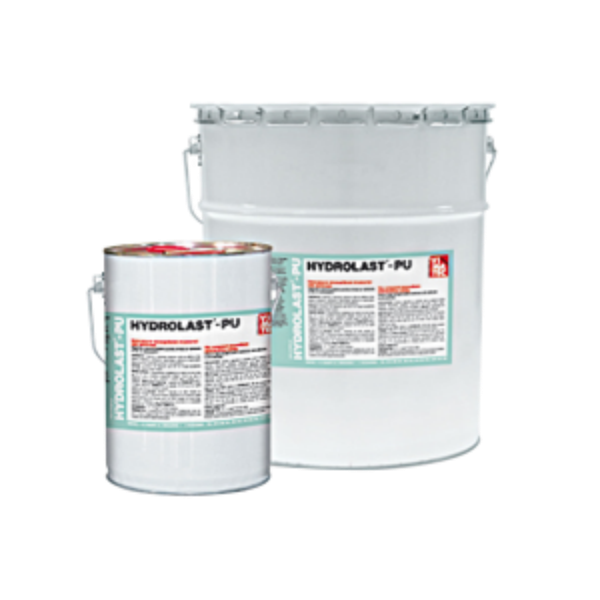
HYDROLAST-PU | Balcony floor waterproofing
Liquid, white polyurethane waterproofing membrane, 800% elasticity
Terrace floor waterproofing
Kitchen floor waterproofing
Waterproofing the garage floor
HYDROLAST-PU | Liquid polyurethane waterproofing membrane.
HYDROLAST-PU is a viscous one-component polyurethane-based liquid that polymerizes after application and forms an elastic membrane with high adhesion to all building substrates.
HYDROLAST-PU description:
-
polymerizes upon contact with atmospheric moisture and creates a single (seamless), elastic, waterproof membrane;
-
completely waterproofs horizontal and vertical surfaces from the outside , providing resistance to positive water pressure;
-
has high mechanical strength and abrasion resistance ;
-
applicable to tanks with stagnant water;
-
due to excellent elasticity, they can cover cracks up to 2 mm;
-
vapor-permeable and allows structural elements to "breathe";
-
provides high resistance to UV and reflects the sun's rays well (providing good thermal insulation in summer) ;
-
does not soften (“does not flow”) in summer and does not harden (does not become brittle) in winter, since it retains its mechanical properties at temperatures from -30 to +80 ° C.
-
HYDROLAST-PU can be applied to both absorbent (concrete, cement mortar, wood) and non-absorbent substrates (metals, asphalt, ceramic tiles, old acrylic coatings).
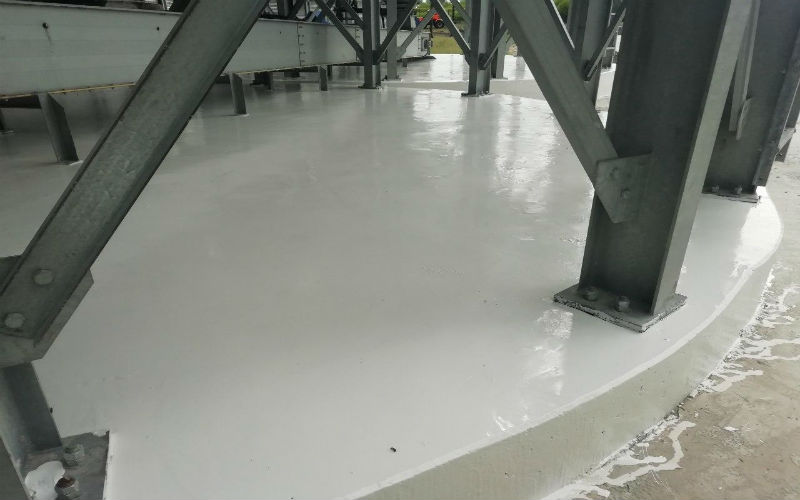
Foundation waterproofing
HYDROLAST-PU is used for:
-
waterproofing and protection of concrete structures such as bridges, tunnels, foundations, etc.;
-
waterproofing of terraces, balconies, inclined and flat roofs;
-
UV and weather protection of bituminous waterproofing membranes;
-
waterproofing under tiles on balconies, bathrooms, kitchens, etc.;
-
protection of heat-insulating layers of polyurethane foam;
- waterproofing florists.
Areas of application for HYDROLAST-PU
-
Waterproofing the floor in the garage.
-
Basement floor waterproofing.
-
Waterproofing on the loggia.
-
Balcony waterproofing.
-
Floor waterproofing in a private house.
-
Floor waterproofing in the apartment.
-
Bathroom floor waterproofing.
- Floor waterproofing in car service.
Specifications |
|
| Compound | Polyurethane resin |
| Elongation at break (ASTM D 412) | 800±80% |
| Tensile strength (ASTM D 412) | 7.45 ± 0.30 N/mm2 |
| Vapor permeability (ISO 9932:91) | 25.8 ± 4.4 g/m2 d |
| Waterproofing (28 1928 Α) | No leakage |
| Adhesion to concrete (ASTM D 903) | >2.5 N/mm2 (concrete pull-out) |
| Shore A hardness (ASTM D 2240) | 65±5 |
| Reaction to fire (ΕΝ 13501-1) | Class Ε |
| Spark reaction and thermal radiation (DIN 4102-7) | Yes |
| Wind load resistance (ΕΟΤΑ, TR-004) | >1.84 N/mm2 (concrete) >0.38 N/mm2 (bitumen membrane) |
| Repairing cracks at +23°C (EOTA, TR-008) | Yes |
| Repairing cracks at -10°C (EOTA, TR-008) | Yes |
| Abrasion resistance (ΕΟΤΑ, TR-011)) | Good |
| Anti-corrosion properties (No. 53420) | Good ones |
| Rain time (+20°C, 50% RH) | 3-4 hours after application |
| Walking Time (+20°C, 50% RH) | 12-18 hours |
| Time of final polymerization (+20 °С, relative humidity 50%) | 7 days |
| Chemical resistance | Good: solutions of acids and alkalis (10%), common detergents, oils and sea water. |
Surface preparation
-
The substrate must be solid, dry, free from dust, oils and contaminants that prevent the adhesion of the HYDROLAST-PU membrane.
-
Old coatings, dirt, vegetation should be removed with abrasive tools.
-
Any surface irregularities must be smoothed out.
-
Any loose particles or pieces should be removed by sanding.
-
Substrate humidity should not exceed 4%, and the relative humidity of the environment should be less than 80%, and the temperature should be between +10 °C and +40 °C.
In particular, cementitious substrates must comply with the following conditions:
-
surface strength ≥ 1.5 N/mm²;
- humidity ≤ 5% (concrete age at least 28 days).
WARNING! Do not wash the surface before applying HYDROLAST-PU with water.
Repair of cracks and expansion joints
-
Cracks must be filled and construction or expansion joints must be filled with PU sealant ( VIMASEAL-PU or VIMAPUR 2K SL/TH .
-
Effective sealing of existing cracks or seams is a condition for the successful application of HYDROLAST-PU .
Sealing (putty) of cracks
-
Cracks are sealed by applying HYDROLAST-PU on a reinforcing PP mesh, the density of which should not exceed 60 g/m², about 20 cm wide, covering 10 cm to the left and 10 cm to the right of the center line of the crack.
-
After cleaning, the surface must be primed with VIMEPOX PRIMER-W epoxy primer.
-
In some cases,VIM PRIMER-S can be used as a primer.
-
After 3-4 hours and after the primer has dried, apply the first coat of HYDROLAST-PU.
-
Lay the reinforcing PP mesh over the crack as above.
-
The mesh is pressed, for example, with a metal roller and embedded in liquid HYDROLAST-PU.
-
Finally, a second (finish) layer of HYDROLAST-PU is applied to create a single seamless coating - the membrane.
Sealing expansion joints
-
If the seam is too narrow, it must be opened (embroidered) to the desired size using a cutting wheel (grinder).
-
The depth of the seam should be from 5 to 15 mm.
-
The width/depth ratio of the expansion joint must be 2:1.
-
After priming VIMEPOX PRIMER-W, apply HYDROLAST-PU with a 20 cm wide brush centered on the joint.
-
A strip of non-woven polypropylene 20 cm wide is placed on the wet material and with a suitable tool (eg spatula) the fabric is pressed deep into the seam so that the inner surface of the seam is covered with fabric.
-
Then, HYDROLAST-PU is again applied over the strip until it is completely covered with it.
-
Then a suitable polyethylene tie is inserted into the joint , and the remaining upper space of the joint is sealed with VIMASEAL-PU polyurethane mastic.
-
Full surface waterproofing may be continued 12 hours after the initial polymerization of the sealing compounds has been completed.
-
The same procedure applies when the concrete has cracks greater than 2mm wide, so it should be opened up and sealed with VIMASEAL-PU.
Primer
To achieve perfect adhesion of HYDROLAST-PU to the substrate, a water-soluble epoxy primer VIMEPOX PRIMER-W is preliminarily applied to the surface (can be applied on a damp surface up to 80%) on porous, absorbent surfaces such as concrete, cement mortars, wood, etc. .
Application of waterproofing membrane
-
The application of HYDROLAST-PU is carried out after the VIMEPOX PRIMER-W has dried (at least after 4 hours) and in any case within 24 hours.
-
Before use, the product must be mixed - homogenized with a low-speed mixer.
-
HYDROLAST-PU is poured onto the primed surface and rolled out with a roller or rubbed with a brush.
-
A second layer is applied after 12-24 hours.
-
Airless application is used for large area substrates.
RECOMMENDATION
-
It is recommended to reinforce - reinforce HYDROLAST-PU with non- woven polypropylene over the entire surface to be sealed.
-
It is essential that the membrane be reinforced at critical points such as floor to wall joints, pipe bends or ventilation ducts.
-
ATTENTION : for optimum results, the temperature during application of HYDROLAST-PU should be between + 5 °C and + 35 °C.
-
Low temperatures slow down the curing process, while high temperatures speed it up.
-
High humidity can affect the membrane surface.
Consumption
-
The consumption of VIMEPOX PRIMER-W is 150-300 g/m² depending on the absorbency of the substrate.
-
The average consumption of HYDROLAST-PU, in the case of a surface of normal porosity and absorbency, is 1.2 kg/m² for two layers, equivalent to a membrane thickness of approximately 750 μm, and 1.5 kg/m² for three layers, equivalent to a membrane thickness of approximately 1,150 mm.
-
If the waterproofing membrane is reinforced over the entire area, it will require three layers with a total consumption of approximately 1.8-2 kg/m² and a membrane thickness of more than 1 mm.
-
ATTENTION: the consumption of HYDROLAST-PU must not exceed 0.6 kg/m² per coat.
- Applying too much material may cause the coating to "swell".
Tool Care
The tools used in the work are washed with water until HYDROLAST-PU is completely dry.
Storage
-
HYDROLAST-PU should be stored in a dry and shady place for a maximum of 12 months from the date of manufacture.
-
The storage temperature must be between +5°C to +30°C.
-
High temperatures adversely affect the shelf life of the product.
-
The product must remain in the original unopened jar.
-
Opened containers should be consumed the same day.
Note
Before applying the material, it is recommended to make a test application on the selected substrate.