

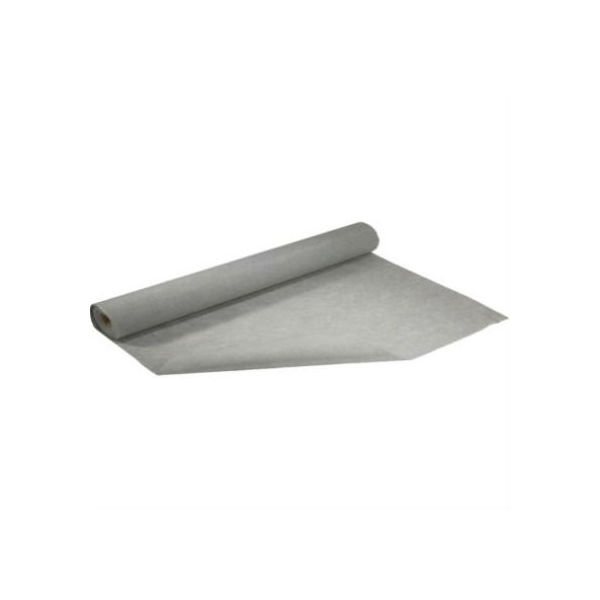
Thermally bonded geotextile for the protection of waterproofing coatings in the construction of concrete floors and screeds
Heat-fixed (thermo-bonded) geotextile is a non-woven material with a density of 120-400 g/m2, produced by heat treatment of fibers, polypropylene or polyester.
Thermofixed (thermobonded) geotextile, due to its quality characteristics:
-
increased wear resistance and good tensile strength, thermally bonded geotextiles are used in the construction of pedestrian roads, at facilities where increased mechanical resistance of the material is required;
- High soil holding capacity, for example, for reinforcing the slopes of embankments of roads, railways, as well as for reinforcing any inclined planes.
Application of thermally bonded (thermofixed) geotextile :
-
protection of waterproofing materials during the installation of concrete floors;
-
construction of roads and railways, as well as temporary roads (in this case, geotextiles can be used both to strengthen the canvas itself or to separate the layers of the substrate, and to reinforce the slopes of embankments);
-
arrangement of footpaths from various materials (asphalt, paving slabs, etc.);
-
protection of the coastline of natural reservoirs or artificial hydraulic structures;
-
construction (to cover concrete);
-
landscape design, where thermally bonded geotextiles are used for drainage, irrigation, soil separation, structural reinforcement and many other purposes;
- in engineering construction to isolate pipelines and strengthen soils near pipeline supports, power transmission line supports, etc.
The advantage of thermally bonded (thermofixed) textiles:
-
high service life of 25 years or more;
-
resistance to solar ultraviolet radiation;
-
the ability to withstand the effects of aggressive environments (acids, alkalis, salts, atmospheric moisture, and others);
-
resistance to decomposition by fungi and bacteria;
-
unattractive to rodents;
- lack of mixing and shrinkage of the soil;
| Surface density |
120 - 400 gr/m/sq |
|---|---|
| Roll Width |
100-200 cm |
| Breaking force along the length |
2.8 kN/m - 8.6 kN/m |
| Breaking force across the width |
2.8 kN/m - 8.6 kN/m |
| Elongation at break in length |
60% - 80% |
| Elongation at break in width |
90% - 100% |


