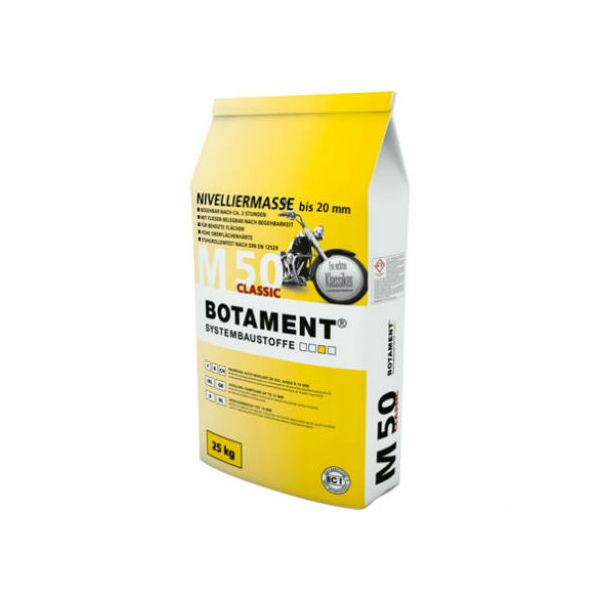
BOTAMENT M 50 Classic | Self-leveling mixture for the floor
Self-leveling, leveling mixture for the floor, up to 20 mm
Leveling mixture for the floor
How to pour the self-leveling mixture?
Self-leveling mixture for a warm floor
Properties
-
Ability to move and lay tiles after 3 hours;
-
Self-leveling mixture for a warm floor;
-
High surface strength;
-
Resistance to roller load, according to EN 12529;
-
Good distribution on the surface (easily distributed);
- Layer thickness for one application: from 0 to 20 mm.
Field of application
-
As a basis, for various types of floor coverings , including with ceramic tiles;
-
As the top layer of the foundation on the passing surfaces;
-
For leveling, it is based in wet rooms;
- Vapor-impermeable floor coverings can be laid on BOTAMENT M 50 Classic only after its complete curing.
Types based
- Concrete;
- Cement and anhydrite screeds;
- Old tiles.
|
The composition of the material |
Cement mixture with mineral fillers and additives
|
|
Packaging |
25 kg
|
|
Storage |
In a dry, cool place, 9 months, in factory packaging
|
|
Density |
2 kg/l
|
|
Optimal amount of water for kneading |
21%
|
|
Mixing proportions |
5.5 l of water/25 kg
|
|
Application time |
30 min
|
|
Maximum layer thickness |
20 mm
|
|
Ability to move |
In 3 hours
|
|
Full load |
In 7 days
|
|
Consumption |
1.6 kg/m/sq/mm
|
|
Compressive strength after 24 hours |
10 N/mm2
|
|
Laying tiles |
In 3 hours
|
|
Application temperature |
From + 5 °C to + 30 °C
|
|
Cleaning agents |
Water for fresh solution
|
Preparation of the base
The foundation must meet the following requirements:
-
dry, clean and unfrozen;
-
the ability to carry a load;
-
cleaned of fat, oil, paint, cement milk, exfoliated and construction debris;
-
cracks must be repaired with BOTAMENT A 60 or BOTAMENT R 70;
-
absorbent surfaces, prime them with primer BOTAMENT D 11 (the primer must dry to form a non-sticky film);
- minimum age of concrete foundation: 6 months;
-
the base must be checked for final moisture, for example, with the help of a hygrometer. The maximum permissible final humidity of the base without heating: 2%; with heating 2%;
- if the base is made of non-absorbent material or old tiles, it must first be primed with BOTAMENT D 15 primer (for use only indoors) or 24 hours before applying BOTAMENT M 50 Classic, apply a thin contact layer of BOTAMENT M 29 glue.
- the contact layer (adhesive layer) must be applied by the slurry method or by the scratch putty method.
Application
- Before applying BOTAMENT M 50 Classic, it is necessary to install a flexible tape for insulation on the perimeter of the room;
-
Mix the mixture with cold, clean water, stirring slowly with a low-speed mixer for at least 3 minutes;
-
After mixing, immediately pour BOTAMENT M 50 Classic onto the base and spread it over the surface to the required layer thickness;
-
Or, as an alternative option, use a machine application method (at the same time, parts of the pump installation with or without the mixture cannot be left after application for more than 20 minutes, since the solution sets quickly);
-
To remove air from the solution, it is necessary to use a needle roller to avoid deposited BOTAMENT M 50 Classic ;
-
The process must be carried out continuously;
-
Do not re-mix the material if it has started to set;
-
If there is a need for a second layer of solution, it should be done immediately after the previous layer hardens and it is possible to move on it;
-
If the first layer is completely dry, before applying the next one, it is necessary to prime the surface with primer BOTAMENT D 11.
Recommendations
-
The maximum filling area should not exceed 40 m2;
-
It is also necessary to pay attention to the existing seams, joints, connections, etc. and, if necessary, close them;
-
If there are deformation seams, they must be duplicated through the entire thickness of the coating;
-
If there is moisture suction from the base, it is necessary to take appropriate measures;
-
BOTAMENT M 50 Classic cannot be mixed with additives and fillers;
-
If BOTAMENT M 50 Classic is applied at low humidity, high temperatures, direct sunlight or drafts, its surface must be protected from rapid drying using coatings;
- On the surface of the solution, traces of the tool may remain and a difference in color may be observed.