Polyex Mesh | Fiber for concrete
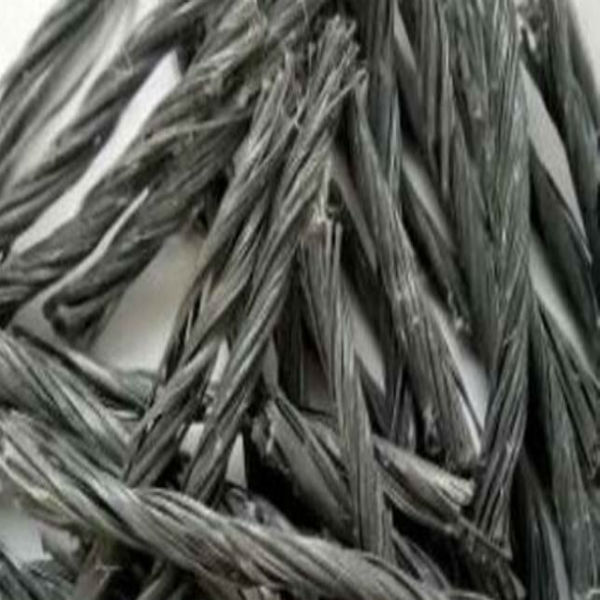
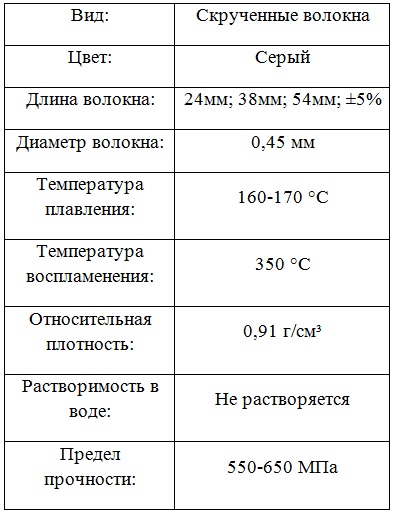
Polypropylene, synthetic reinforcing fiber, for concrete floors, length 54 mm
Crack resistant concrete
Concrete admixture
Reinforcing fiber for concrete
Polyex Mesh | These are fibers consisting of a special mixture of copolymer and polypropylene.
-
Fibers for concrete floors , create reinforcement in three dimensions, which reduces or completely eliminates the plastic shrinkage of concrete, is a replacement for reinforcement with steel fibers, reinforcing cage and anti-shrink meshes.
-
Polyex Mesh fibers are available in the following lengths: 24mm; 38mm; 54mm.
-
A variety of fiber lengths provides convenient dosing, mixing and even distribution in the cement matrix.
-
Such fibers absorb the maximum energy of crack formation in concrete.
- Energy absorption determines the strength factor and is an indication of the effectiveness of fiber reinforcement.
Properties of synthetic fiber
-
Polyex Mesh | Starting from a small dosage, polypropylene fiber for concrete provides a reduction in the amount of reinforcement in all concrete slabs (on the ground and on the finished reinforced concrete floor), as well as reinforced concrete elements.
-
The length of the fibers is also ideal for thin reinforced concrete elements, for enclosing structures.
-
Polypropylene fibers for concrete improve architectural and consumer quality, increase concrete tensile strength and bending strength.
-
Concrete and mortar using polypropylene fibers made from Polyex Mes h structural fiber has better properties compared to concrete reinforced with steel fibers.
- Polyex Mesh increases the impact strength of concrete, its resistance to corrosion, fibers stop shrinkage caused by early cracking of concrete, and also increase its density.
Benefits of using Polyex Mesh in concrete
-
Improving the impact strength of the concrete floor.
-
Fiber for concrete, increases the bending strength of the concrete floor.
-
Reducing the formation of shrinkage cracks in concrete.
-
Increasing the resistance of the concrete floor to weather factors.
-
Increasing the cycles of frost resistance of the concrete floor.
-
No corrosion in concrete.
-
Reinforcing fiber for concrete, increased wear resistance of concrete floors.
-
Better concrete workability;
-
Increasing the durability of the concrete floor;
-
Substitute for steel anti-shrink meshes in concrete floors.
-
Anti-electrostatic concrete floor;
-
Additional resistance to crushing of concrete;
-
Convenient dosage and mixing in concrete;
-
Uniform distribution of fibers in the concrete mixture;
- Reducing the wear and tear of concrete supply equipment;
Recommended use :
-
road and bridge surfaces;
-
outdoor areas, parking lots;
-
concrete floor slabs, foundations;
-
monolithic structures, reinforced concrete piles, concrete columns;
-
mortars, dry mixes and plasters;
-
casting of small architectural forms from concrete;
-
pouring on a soil base;
-
in the production of reinforced concrete products, trays, drainage systems, containers (with drinking water), pools, elements of enclosing structures, shotcrete and other concretes of class from B-5 to B-100 MPa.
Why use fiber?
-
A concrete structure is always strong, but not always plastic.
-
Based on this, tensile forces, plastic deformations, shrinkage cracks, etc. often occur in concrete structures.
- In this case, often the reinforcing cage can not cope with the resulting loads.
-
Accordingly, the addition of fiber fibers to such structures makes it possible to remove shrinkage cracks, significantly increase the resistance of cracking, and therefore the number of cracks will be minimal.
-
Also , fiber for concrete allows to reduce internal stress in concrete and makes concrete more ductile, more elastic and suitable for long-term operation under dynamic loads.
-
The composition of the fiber in concrete is selected based on the thickness of the concrete, on the expected loads on this concrete structure, and taking into account the technical conditions in which it will be operated.
-
In the event that we just need to eliminate microcracks, we can use BELMIX polypropylene fiber from 600 to 900 gm 3.
- In case we need to make a full-fledged concrete reinforcement for more complex operation, Polyex Mesh co-polymer fiber should be added and added in a proportion of 1 to 3 kg per m 3 , and its length is selected based on the thickness of the concrete, in order to these fiber fibers did not protrude onto the surface of the concrete pavement.
|
Layer thickness mm |
Polyex Mesh 24/38/54 |
|
>70 |
Polyex Mesh 24 |
|
70-120 |
Polyex Mesh 38 |
|
120-200 |
Polyex Mesh 38/54 |
|
200< |
Polyex Mesh 54 |